
The Construction of the National Theatre

An artistic event, unusual in the 19th century, was the arrival of Maestro Lorini’s “Italian Opera Company” in 1862, a true social event, which our great-grandmothers, dressed in their finest jewels and finery, attended. and for a long time afterward, they recounted anecdotes from that party and described the beautiful dresses they wore to such a grand event. Due to the poor conditions of the hall where it was held, the idea was born that culminated in the construction of the National Theater.
It became a national obsession to have a theater suitable for staging operas and comedies. At the time, there were only three theaters, two of them poorly built and of low quality: Teatro Colón, El Municipal, and later the Variedades, which still exists today.
An interesting fact about the programs and how to attend the performances was this: People with shoes, bringing their own chairs, paid fifty cents for “standing room,” while barefoot people paid twenty-five cents.
While in Guatemala, the great French actress Adelina Patti was recommended to visit San José because of Costa Rica’s rich culture.
She came to San José, but when she saw the existing theaters, she couldn’t perform because they weren’t adequate and lacked curtains, furniture, etc. This bothered the educated people, who were Costa Ricans and members of the French, English, Spanish, and Italian communities, as well as professionals who had been educated in Europe, especially in London, so much that they decided to ask the government to build a proper theater and to finance its construction. The majority of coffee growers and merchants offered to voluntarily pay a new tax on coffee.
Dr. Carlos Durán was acting as interim governor, and the request was addressed to him in the following terms:
The undersigned merchants and farmers, desirous that a theater be constructed for the leisure and enjoyment of the population, and convinced that a capital city such as ours should not be without such a venue, and that national revenues do not produce a surplus sufficient to undertake the project, hereby offer to pay, for this purpose and for as long as may be necessary, five cents for every arroba of coffee exported, an amount that would yield approximately 70,000 pesos annually, provided that our proposal for a general tax on coffee exports be enacted into law. This tax would allow the theater to be built gradually, in proportion to its annual yield, and, if necessary, to guarantee repayment of any loan obtained to finance the construction.
Please accept our offer and proceed as you consider appropriate.
S. A. Federico, S. Guzmán, Ricardo Montealegre, José Antonio Lara, on behalf of Herrán Hermanos, Francisco Alvarado, Braulio Morales.
San José, March 1st, 1890.
Cleto González Víquez.
EM. Millet.
Luis Ellinger and Brother.
F. Esg and Cía. J. R. Troyo and Cía.
José María García.
Salvador Lara.
Jaime G. Bennett.
Mariano Montealegre.
Juan Hernández.
Walter J. Ford.
G. Herrero y Co.
Macaya and Rodríguez.
Montealegre and Carazo.
William Le Lacheur Lyon.
E J. Alvarado.
Pedro Torres. A.
Gallardo. L. E
Jiménez Gordiano Fernández.
Ascención Esquivel.
Luis Fernández.
E de Fernández.
Echeverría and Castro.
J. R. Mata.
Félix A. Montero.
Pagés Cañas and Cía.
Ortuño and Cía.
Cecil Sharpe.
Esmeralda de Morales.
C. R. Cortés.
A. Collado.
José Joaquín Trejos.
Julio Piza.
Ric. F. Cooper.
A. E. Jiménez.
Máximo Fernández.
F. Peralta.
Juana de Echeverria.
Walter J. Field.
José Mercedes Rojas.
J. Alfaro.
Uribe y Batalla.
The previous request was very well received by Dr. Duran, who brought it to the attention of Congress through the then President-elect, José Joaquin Rodriguez, who, having just begun his term on May 8, 1890, sent it to Congress, and by the 20th of that month, it was already law of the republic in the manner described below:
DECREE XXXIII.
Execute: José Joaquín Rodríguez. Joaquín Lizano. Minister of Public Works.
The Constitutional Congress of the Republic of Costa Rica, at the initiative of the Executive Branch, and CONSIDERING:
That the construction of a National Theater in the Capital City is a social necessity, demanded by the civilization of the country, and that this improvement is also requested by a considerable number of merchants and farmers, who offer to contribute voluntarily with a tax of twenty cents for every forty-six kilograms of coffee exported, that this circumstance removes from the tax established below the odious character that tends to burden the products of national industry. DECREES: Article One. The theater in the capital of the Republic is hereby declared a national project.
Article Two. The Executive Branch is authorized to invest up to two hundred thousand pesos from the National Treasury in the construction of the NATIONAL THEATER.
Article Three. To carry out this work, a tax of twenty cents for every forty-six kilograms of coffee exported is hereby established, collectible for as long as necessary to cover the theater’s budget, and once the budget is fulfilled, the tax shall be abolished.
Article Four. The Executive Branch shall regulate the manner in which the tax is collected. Article Five. To accelerate the work, the Executive Branch is empowered to raise a foreign or domestic loan of up to two hundred thousand pesos, which it shall pay with the proceeds of the tax, which it may give as a guarantee of payment.
To the Executive Branch, given in the Session Hall of the National Palace in San José on the twenty-eighth day of May, eighteen hundred and ninety. Francisco María Iglesias. President. J. Vargas M. Secretary. Féliz Mata V. Secretary.
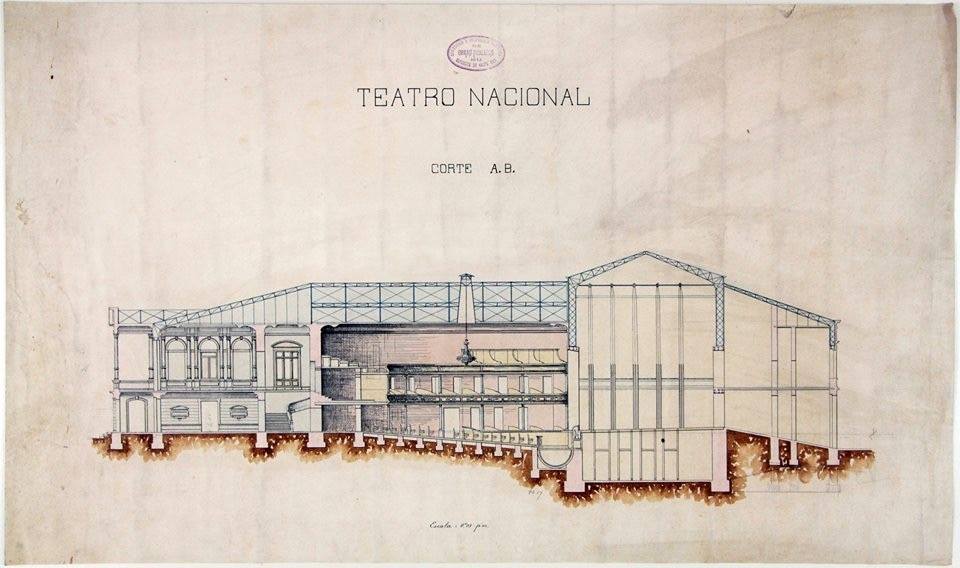
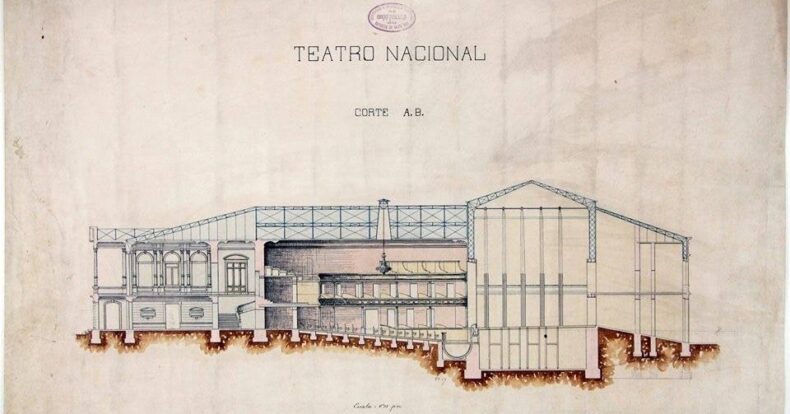
First sketch of the National Theater of Costa Rica, 1890
The theater’s plans were drawn up by Belgian engineers, sought out in Europe by Costa Rica’s Minister Don Manuel Maria de Peralta, and most of the materials and workers came from Italy, also sought out by the Minister Peralta.
Costa Rican engineers Miguel Angel Velázquez, Luis Matamoros, and Nicolás Chavarría oversaw the construction of the building, with Antonio Varela serving as master builder and Pedro and Fernando Reigh as German architects.
Decorators: Serra, Andreoli, Ferrando, Guevandu, Ferrario, and Fontana.
Sculptors: Pietro Bulgarelli and Adivatiro Froli, along with Juan Ramón Bonilla from Costa Rica, Tomás Povedano, Luigi Vignani, Andreoli, Rampaggini, Doninelli, Albertazzi, Betoni, Zunda, Rigioni, Piagnini, Villa, Ferraño, Pallini, Ruscalli, and the electrical work was carried out by Engineer Rampazzini.
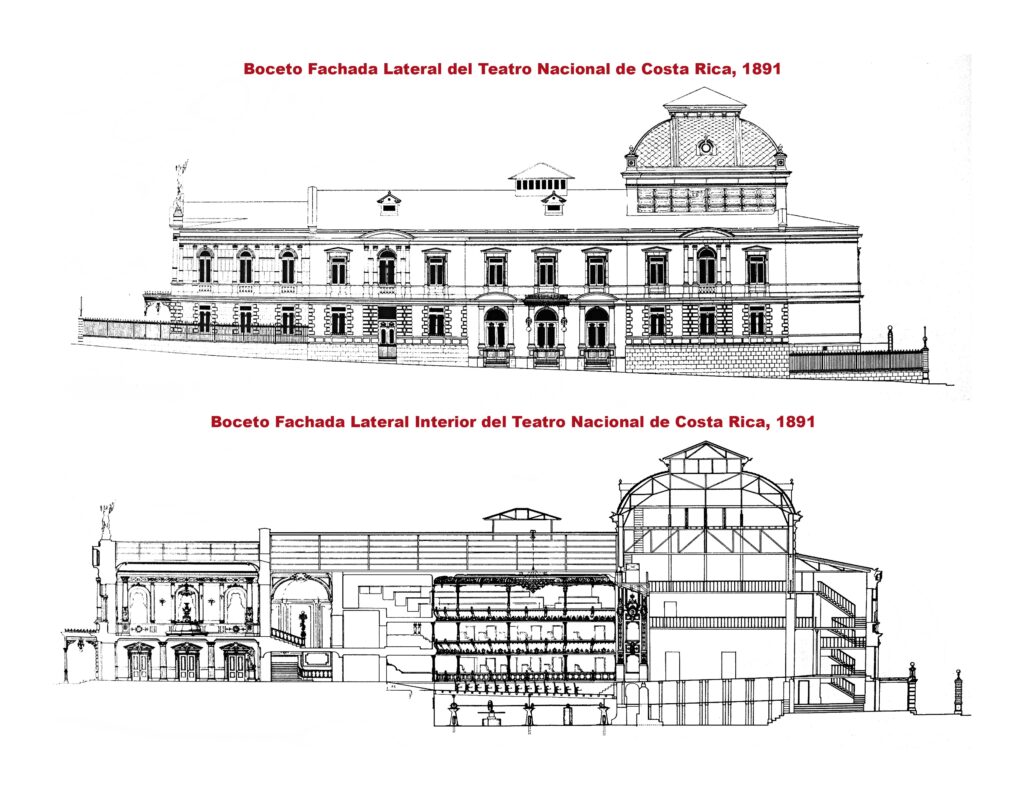
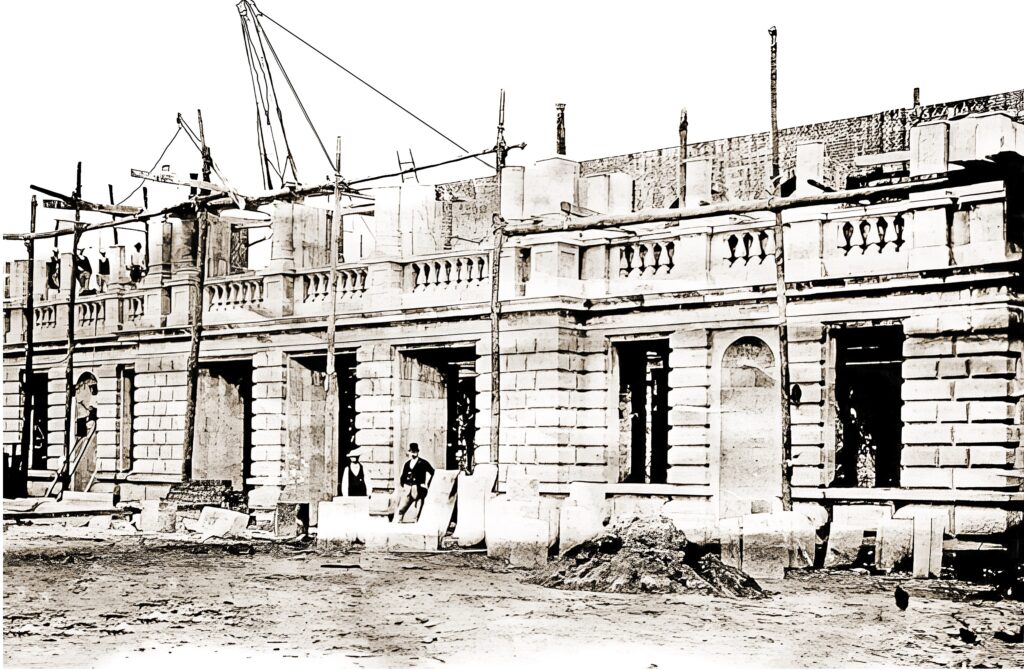
The monumental and emblematic National Theater of Costa Rica, under construction in 1896.
The perfection of the details in the eclectic architecture of the walls, built with stone and granite brought from quarries in Cartago and bricks manufactured in the country under the direction of Enrique Invernizio, is noteworthy. All the precious woods used in this great architectural work, such as cedar, pochote, mahogany, medlar, cocobolo, ronrón, and quizarrá, were brought from Alajuela.
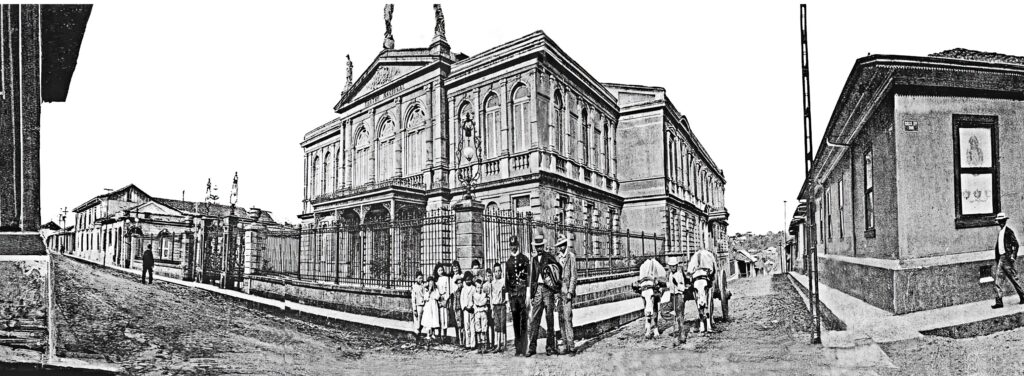
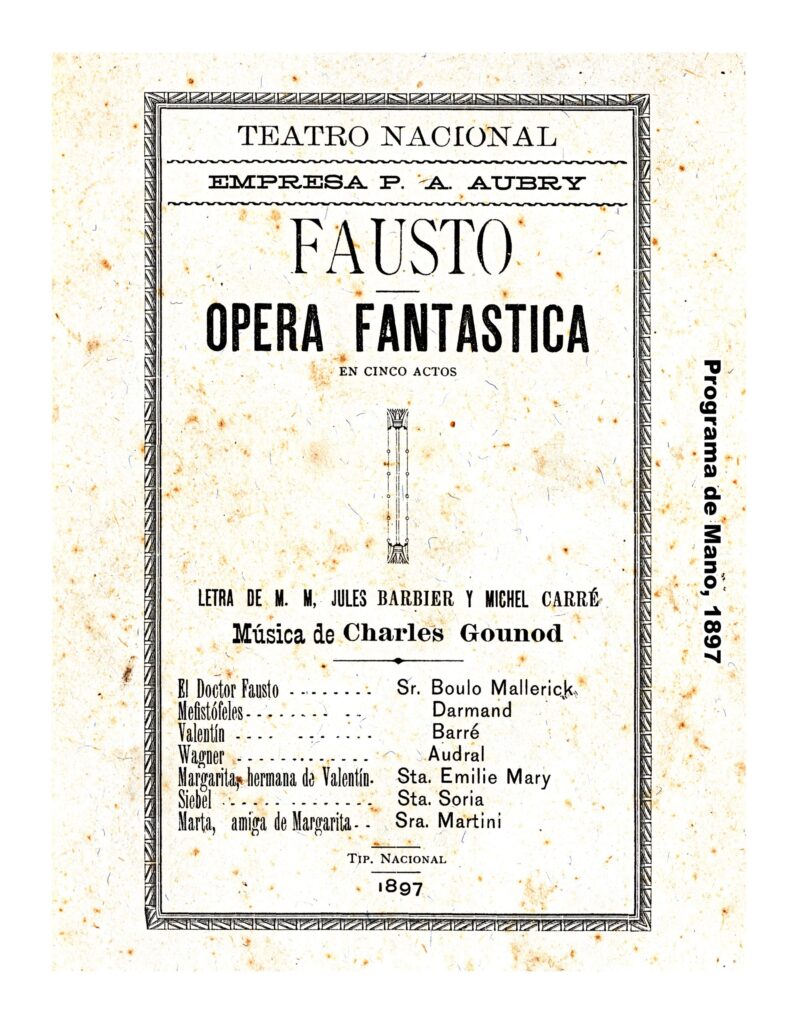
Six years of construction work were completed on October 19, 1897, when the theater opened with a performance of Charles Gounod’s opera Faust by the French Aubry Company.
At this grand event, the first thing was to sing our National Anthem and then La Marseillaise, because the founding company was French.
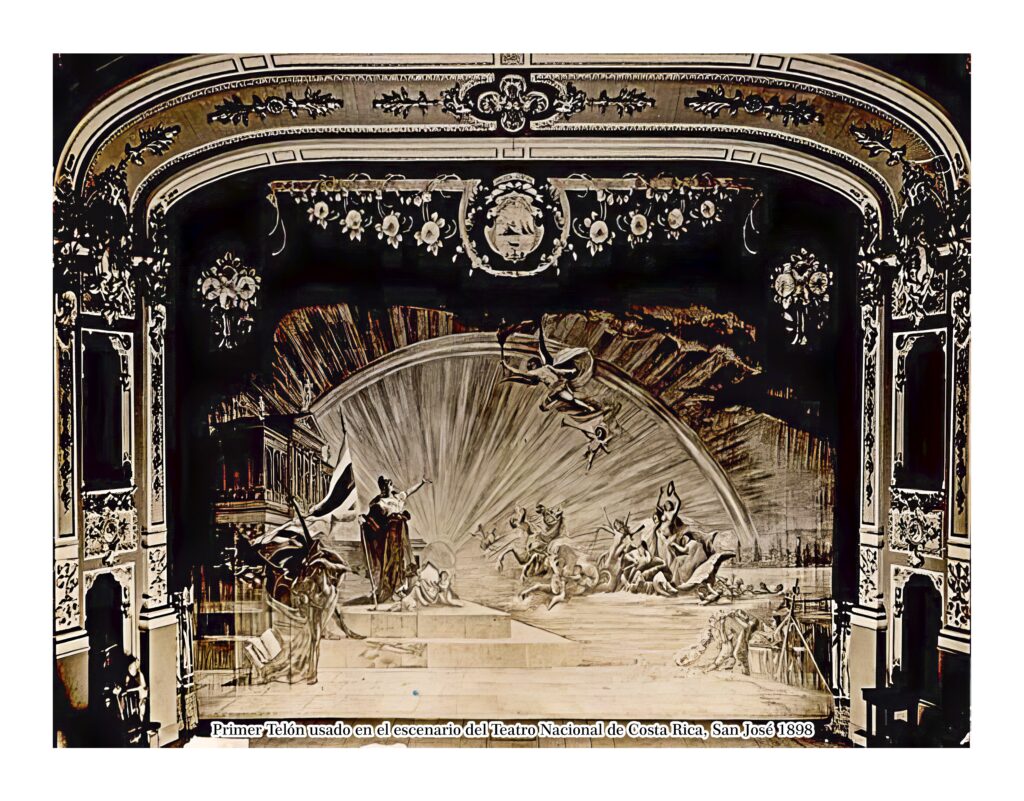
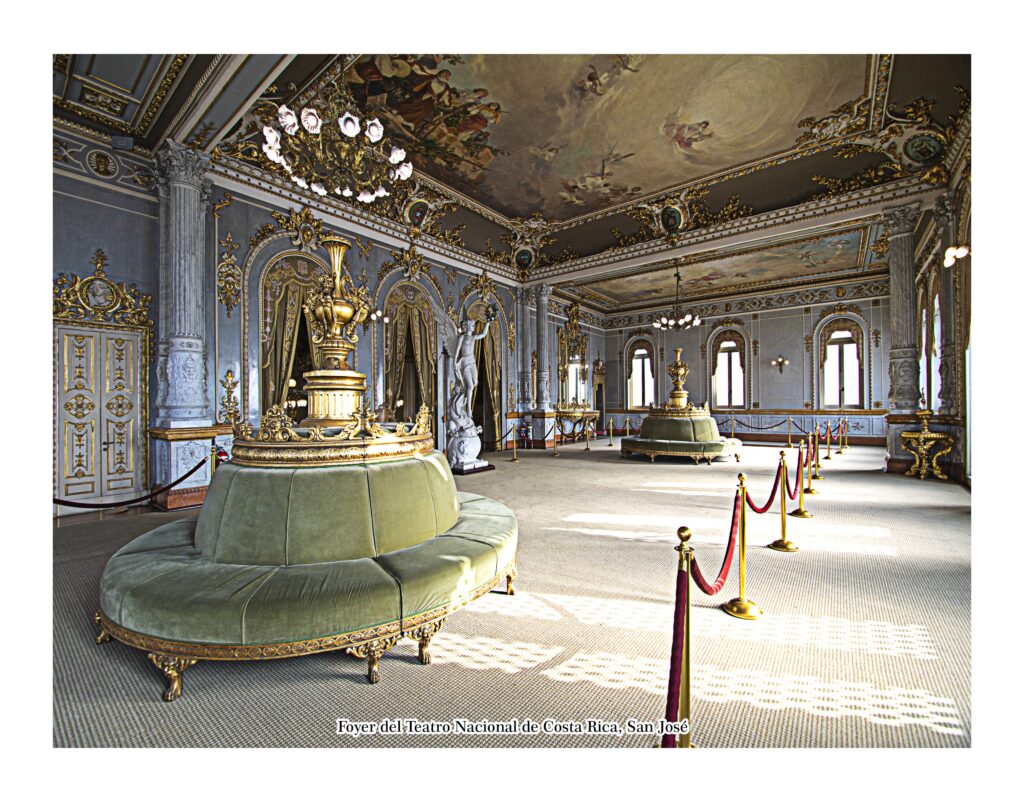
The most important parts of the National Theater are: the facade, the lobby, the main staircase, the foyer, and the auditorium. Inside the building, you can appreciate a delicate neo-Renaissance style with imposing pure crystal chandeliers and Carrara marble columns. The lobby, built with Pompeian influences, is considered by many to be one of the most beautiful parts of the theater.
The front of the theater is impressive, with statues of Music, Fame, and Dance, and statues of Beethoven and Pedro Calderón de la Barca on either side of the entrance. Costa Rica’s National Theater was declared a National Monument in 1965.
This gesture of civic virtue and magnanimity by our people, undertaken at the very dawn of their economic independence, scarcely a hundred years after Vázquez y Téllez introduced coffee to the country and its cultivation became widespread and firmly established, is hardly ever mentioned, even though everything was the result of their labor and generosity. Not even the first centenary has been commemorated; yet when the second centenary is reached, it should be celebrated in their honor, at the very least by declaring Vázquez and Téllez National Benefactors posthumously.
Previous article International Arts Festival (FIA): A Ten-Day Celebration of Culture and the Arts in March 2026
Navigate articles